
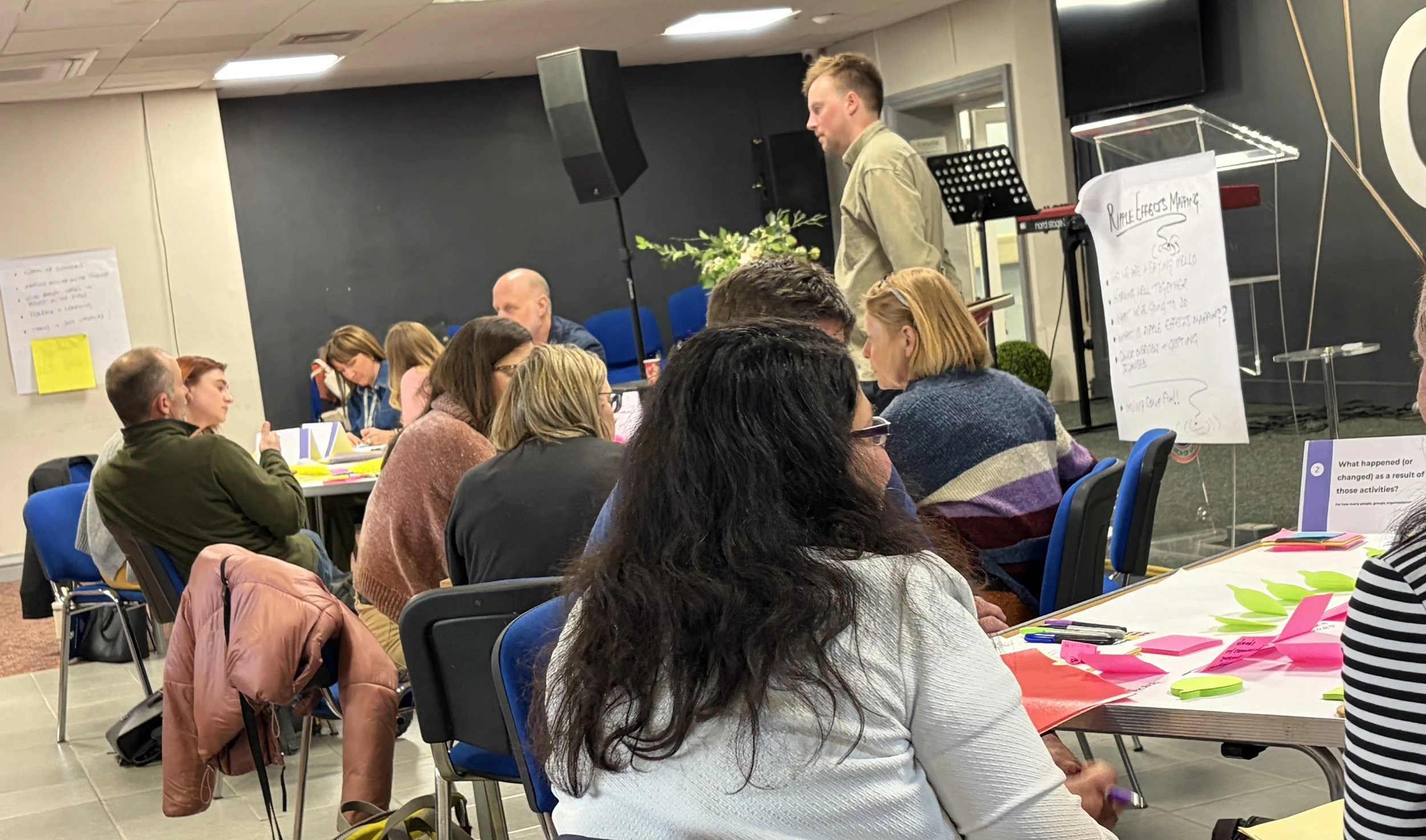
Earlier this year myself and colleague Tim Bidey worked with Beth Fletcher and a diverse group of voluntary and community sector partners to evaluate funding to help tackle health inequalities around low uptake of COVID-19 vaccinations. The funding was used to support a community empowerment programme aimed at increasing vaccine uptake across Derby and Derbyshire.
Using Ripple Effects Mapping to really explore the intended and unintended consequences with those directly involved demonstrated that effective engagement is not primarily achieved through information campaigns alone, but through sustained, culturally responsive, community-rooted approaches that build trust, strengthen local capacity, and create safe spaces for conversation.
What was perhaps the most poignant piece of learning was how the community empowerment approach used by Beth and the team delivered wider benefits well beyond vaccination, including increased confidence, stronger community participation, improved advocacy, greater systems learning, and the development of longer-term community and public health infrastructure.
By strengthening relationships, confidence, local leadership and safe spaces for dialogue, the work created conditions that support wider sensitive health conversations across issues such as mental health, sexual health, obesity and preventative care. Demonstrating that community-rooted, relational approaches function not simply as communications activity, but as long-term public health and prevention infrastructure that can improve inclusion, reduce stigma, strengthen community resilience and support earlier engagement with health services across a range of complex health inequalities.
The power of strategic commissioning
Strategic commissioning has a critical role to play in enabling more embedded, relational and community-rooted models of public health and prevention. The findings demonstrate that trusted relationships, local leadership and sustained community presence are central to addressing health inequalities, particularly where trust, stigma and exclusion shape engagement with services. This requires a shift away from short-term, transactional commissioning towards longer-term investment in community infrastructure, local capacity and place-based partnerships. By commissioning for relationships, trust and prevention capacity, rather than activity alone, systems can create the conditions for more effective, culturally responsive and sustainable engagement across a wide range of complex health issues.
Top tips for making the shift…
Move from short-term campaign funding to longer-term community infrastructure investment: confidence and community participation develop gradually through sustained local relationships rather than short-term engagement activity.
Commission for relationships, trust and participation. Shift commissioning models away from too much focus on outputs and activity to capture the value generated through relational engagement approaches.
Develop a Community Health Champions model. The evaluation findings support the value of trusted community leaders and champions in supporting sensitive health conversations.
Embed community engagement within place-based prevention approaches. The projects consistently demonstrated that engagement was most effective when rooted within existing community spaces, relationships and local ecosystems.
Expand culturally responsive approaches. The evaluation demonstrated the importance of culturally appropriate communication, accessible information and trusted messengers.
Invest in psychologically safe community spaces for health dialogue. Across all projects, safe and non-judgemental environments emerged as one of the most important conditions for successful engagement.
Recognise and resource the wider ripple effects of community engagement. The Ripple Effects Mapping workshops demonstrated that the projects generated wider impacts beyond vaccination alone.
Strengthen feedback loops between communities and system. The projects highlighted the importance of communities not simply receiving information but shaping engagement approaches and influencing system understanding.
Build systems capability in relational and community-led engagement. The REM findings demonstrated that the work generated important systems learning around trust, silo working, place-based practice, community expertise and relational public health approaches.
Use Ripple Effects Mapping as part of evaluation and learning. The REM process surfaced important outcomes that were not fully visible through traditional reporting methods.
To read all about the project in Derbyshire check out this link.