
There is a lot changing around patient voice at the moment. Healthwatch faces an uncertain future, we are thinking differently about devolution and the role of communities, and there is a real opportunity to consider how people can have greater influence over the decisions that affect their lives. There is much about that which feels positive.
But I also have a nagging sense of déjà vu.
In 2008, I wrote an article called Putting People at the Heart of Public Services: Can We Make it a Reality this Time? It came after a period of considerable change and disruption to the infrastructure for patient and public voice. Community Health Councils had gone. Patient and Public Involvement Forums had been created, only to be dismantled again. The latest answer was Local Involvement Networks, or LINks.
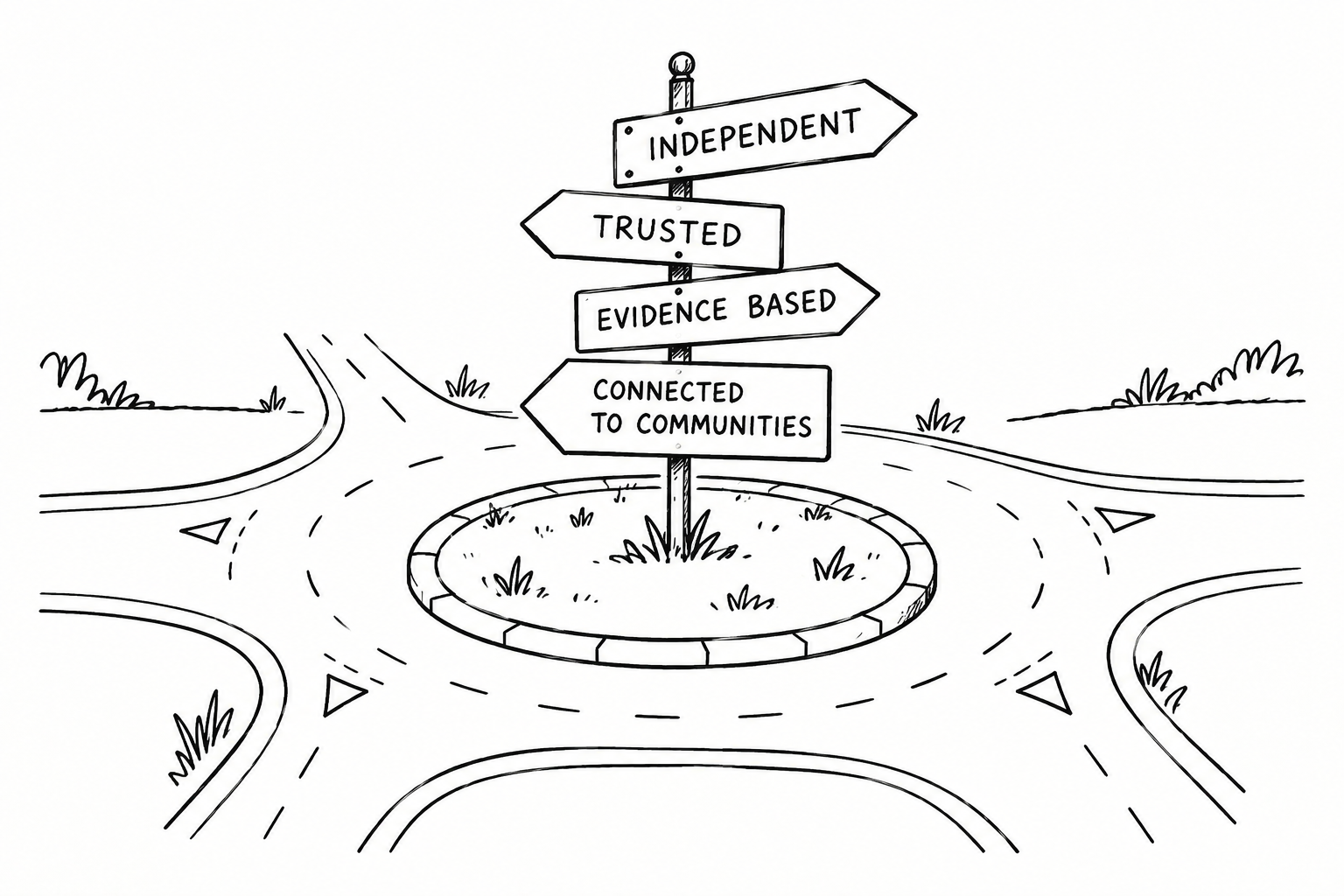
Nearly twenty years later, we find ourselves at another roundabout.
I have worked in and around every incarnation of England's statutory patient voice arrangements. None was perfect and all taught us something. We have made enormous progress in how we understand lived experience, community power and people's right to influence the services and decisions that affect them.
So, my concern is not that things are changing. Change can create opportunities to do things better. My concern is that periods of structural change also create disruption. Attention inevitably turns inwards to contracts, organisations, staff, governance, accountability, money and where functions will sit next. Meanwhile, people are still using services. They are still trying to tell us what is happening. And sometimes what they are trying to tell us really matters.
While we are redesigning the infrastructure for patient voice, we need to make sure we do not miss the voices that matter, at the time they matter most.
That is why I think this moment calls for us to start not with the structure, but with what we already know.
The recent Picker review of the history from Community Health Councils onwards identifies some remarkably persistent themes, including independence, meaningful rights and powers, sufficient resources and the connection between what is heard locally and influence nationally.
The King’s Fund reaches strikingly similar conclusions. I was interviewed as part of its research into what can be learned from the Healthwatch model. Its findings highlight the importance of independence, strong local relationships, rich community insight and the ability to connect what is heard locally with influence at system and national level.
None of this feels particularly new to me. And perhaps that is the point.
The words I carry with me
Between 2010 and 2012, I led work in Mid Staffordshire following the catastrophic failures in care there. Much of that work was directly with people who had been bereaved and harmed.
I still carry their words in my work every day.
Again and again, people talked about trying to raise concerns and feeling that what they were saying had been minimised, dismissed or ignored. Their experience had not found its way to the people who needed to hear it. And the consequences were not abstract. People were harmed.
So, when we started thinking about what should come next for patient voice, we were not designing from a blank sheet of paper. We were designing with those experiences in the room.
The principles people identified were actually quite simple. Whatever came next needed to be trusted, evidence based, independent and connected to communities.
We were also acutely aware that patient voice structures had already been created and abolished several times. How could we create something that would be harder to simply dismantle the next time the machinery changed?
That thinking influenced the design of what became Healthwatch. Rather than another set of institutions owned by the system, Healthwatch was designed around a brand, functions and contracts that could be delivered through independent local arrangements rooted in communities.
There was an important principle underneath that design.
The voice of the public belongs to the public.
Not to the NHS. Not to local government. And, actually, not to Healthwatch either.
Healthwatch was designed as infrastructure to help that voice travel.
There was a reason independence mattered. The families we worked with in Staffordshire understood, through the hardest possible experience, what could happen when the organisations responsible for care were also relied upon to hear, interpret and act on people's concerns about that care.
That lesson feels fundamental now.
Independence matters
You can transfer a statutory function relatively easily. You cannot transfer trust quite so easily.
If a Local Healthwatch has done its job well, its most valuable assets may be the relationships built over years, the community organisations that pick up the phone, the people who trust someone enough to tell them what happened, the knowledge of which voices are missing and the ability to recognise that apparently separate stories might actually be telling us the same thing.
This is not necessarily an argument for keeping every Healthwatch exactly as it is. There is an opportunity to improve, to think differently and to build something better where that is needed.
But nor should we assume that national change means dismantling what works locally.
Current proposals allow flexibility in how patient voice functions are delivered locally, including the option of commissioning organisations equivalent to Local Healthwatch. So where an existing Healthwatch has built the independence, trust, reach and relationships its community needs, retaining and strengthening it should surely remain an option.
Form needs to follow function.
Lets start by asking what people and communities need now. What needs to remain independent? What relationships already exist? Who is trusted? Who is not being heard? What enables difficult messages to reach the people with the power to act?
Then decide what the model should look like.
Power closer to communities
There is something else happening now that makes this conversation particularly timely.
The new government under Andy Burnham is placing considerable emphasis on devolution and moving power closer to places and communities. That creates an interesting opportunity for patient and public voice.
We already know that strong communities are not created by institutions deciding to engage with them. They grow through relationships, local organisations, community spaces, voluntary action and people who understand their place and each other.
If devolution simply moves power from one large institution to another, we have not necessarily brought it much closer to people. The opportunity is to make sure power travels further, into neighbourhoods and communities, with the infrastructure and resources that allow communities genuinely to exercise it.
That aligns well with what we learned in Staffordshire: trusted, evidence based, independent and connected to community.
And independence matters here too. The closer decisions get to communities, the more important it is that communities have an independent means of speaking to those making them.
Community power and independent voice should reinforce each other.
We are not starting again
Reading my 2008 article could leave me feeling that we have spent nearly twenty years going round in circles. But I do not think that is true. A huge amount has changed.
Lived experience is much more widely recognised as a legitimate and valuable form of knowledge. Coproduction has moved from the margins into the mainstream language of health and care. We understand more about power, inequality and why some people and communities are consistently less likely to be heard.
Practice has matured too. Across the NHS, local government, Healthwatch and voluntary and community organisations there are people with deep expertise in working alongside communities rather than simply consulting them. People with lived experience are shaping research, improvement, commissioning, policy and governance in ways that would have been much less familiar twenty years ago.
That progress matters.
We are not starting again. Or at least, we shouldn’t.
The opportunity now is to take everything we have learned and ask: what independent infrastructure for public voice do our communities need for the next era of health and care?
Some places may conclude that what they already have in Healthwatch is valuable and should be retained and improved. Others may want to build something different.
Either way, the questions are quite simple. Is it independent enough to say what the system may not want to hear? Is it trusted by communities? Can it reach people whose voices are too easily missed? Can it connect individual experiences and see the bigger pattern? And can it get that insight to the people with the power to do something about it?
Nearly twenty years ago, I asked whether we could make putting people at the heart of public services a reality "this time". Perhaps the thing I understand more clearly now is that there will probably never be a perfect structure for patient and public voice.
Structures change. Governments change. Organisations change.
The public's voice does not belong to any of them.
Our job is to create the conditions in which that human voice can be heard, particularly when it is difficult, inconvenient or telling us something we would rather was not true.
Some of the people who taught me that lesson did so through the worst experiences imaginable. I still carry their words with me.
We owe it to them, and to the people trying to be heard today, to build on what we know.
Form needs to follow function.
This blog is written in memory of the truly inspirational Professor Bob Sang